The Tenkara Fishing Blog is a mini journal about tenkara. It will let you know whenever any new pages on TenkaraBum are uploaded or if there are significant changes in existing pages. It will also help keep you up to date with what's new in tenkara fishing in the US.
Feb 5, 2012
Tenkara Hooks
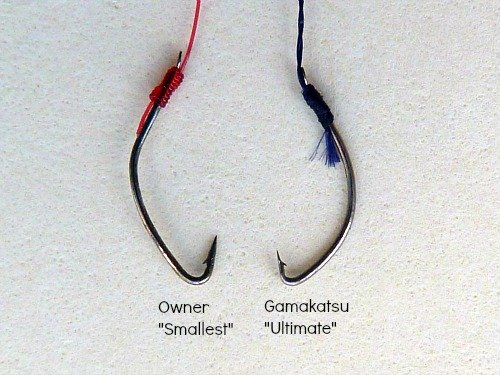
They do exist! Tenkara hooks! Designed specifically for tenkara. Do you absolutely have to have them? Of course not. You can use any hook you want. However, just as rods were designed specifically for this type of fishing, and lines were designed specifically for this type of fishing, there are indeed hooks designed specifically for this type of fishing.
Owner, a well known maker of hooks in Japan, has two different hooks that they label as "Tenkara" or rather as テンカラ. Or, to be a bit more precise, 本流テンカラ, or Main Stream Tenkara and 桑原テンカラ, or Kuwabara Tenkara (Gentatsu Kuwabara is one of the oldest tenkara fishermen in Japan and Owner designed a hook to his specifications).
When I was a kid I used to fish a little pond right at the edge of town. It had lots of sunfish and bullheads and a few crappies. I don't remember catching any bass, but they were probably in there. It was stocked with trout each year for the town's annual "Huck Finn" day, in which all the kids dressed up as Huck Finn, Tom Sawyer or Becky Thatcher and paraded down Main Street. Being on the plains rather than in the mountains, the water was too warm and any trout that didn't succomb to night crawlers probably did to the heat.
I have a few good memories of fishing that pond, but the one that is the most distinct is wanting to catch the fish I could see. It was of no importance that the fish further out, that I couldn't see, were much larger than the ones I could. Of course the ones I could see were little sunnies that could not have been 3" long. It didn't matter. Those were the ones I wanted to catch.
As I got older I fell in with the "normal" quest to catch bigger and bigger fish, but the interest in small fish never went away. Not long after I learned about tenkara fishing I also ran across tanago fishing.
Tanago are small fish and they don't live in pristine mountain streams. People fish for them though, and they can be as fanatical as any trout or bass fisherman.
Near as I can tell, there are no tanago ("bitterling" in English) in the US, but there are people here who do fish specifically for small fish. TanagoBum will be an offshoot of TenkaraBum that will explore the quest for the small fry, or Micro-fishing as it is called. Like the fish, though, it will be small and will probably only appeal to those whose interests are not necessarily in the main stream.
The Dr Slick Mitten Clamp is an excellent alternative to sticky forceps or hemostats. If you fish smaller mountain streams - the kind for which tenkara is ideal - you will catch wild fish. Most wild fish, particularly in the smaller streams, tend to be small. To remove a hook from a small fish it really helps to have a tool and flyfishermen generally use a pair of hemostats.
For some time now, I've been using a pair that were very cheap, very effective and very, very shiny. Cheap and effective is good, shiny isn't. To replace them, I turned to industry leader Dr. Slick.
Like the whole ethos of tenkara, the Dr Slick Mitten Clamp is simple. Just squeeze. The squeeze tightens the clamp and engages the teeth that hold it shut.
There's no "stopper" though, so if you keep squeezing, the catch goes past all the teeth and that releases the clamp. The clamp has a spring that will open the jaws by just relaxing your grip, but the catching mechanism now slides behind the back side of the teeth so they don't engage.
Tenkara at Somerset. Well, the show's over, the backdrop and the "spaceship" Tenkara USA banner are packed up and the crowds are gone.
Even though there aren't the same ripples as there were after the chance encounter between Lefy Kreh and Daniel Galhardo at the Marlboro, MA show, I think tenkara still made a splash. The ripples from this show may be more subtle, but I bet they'll be more far reaching.
Is tenkara a fad? It seems Lefty Kreh thinks so. To be fair to Lefty, I suppose one should agree that only time will tell.
However, a fad is generally considered to be something that is here today and gone tomorrow - an idea or a product that doesn't last very long. Tenkara, or more broadly, fishing with an artificial fly and a line tied to the tip of the rod, which is what I am pretty sure Lefty had in mind, has been around a long, long time.
The first written account of that type of fishing was penned by Aelian around 200 AD. It is almost certainly much older than that. To assume that something did not exist before it was first written about is like saying dinosaurs did not exist before the word "dinosaur" was coined in 1841. Illogical to say the least.
So, tenkara-style fishing has been around at least 1800 years. Maybe it is a fad. But then, the printing press has only been around 570 years. Perhaps it is a fad as well.
How about reels on fly rods? Being generous as to what constitutes a reel, maybe 360 years, if the rudimentary drawing in Thomas Barker's 1650 book "The Art of Angling" can really be considered a reel. (To be fair again, that confusing piece of equipment could have been around for a while before he wrote about it, though.) Maybe reels are a fad. Or at least the double haul, first demonstrated in only 1934. A mere 70-odd years. Surely it's just a fad.
The telephone is only 135 years old. It might be a fad. Or light bulbs (133 years), or airplanes (107 years), programmable computers (70 years). How about graphite fly rods (less than 30 years).
Pet rocks were a fad. they didn't provide much usefulness to their owners. Tenkara rods, on the other hand, give you a way to fish a smaller stream that just cannot be matched with a shorter rod and a heavier line. People who've used them understand that (at least the ones who used a light enough line to keep it off the water's surface and kept their rod tip high enough to do it effectively).
I strongly suspect that long rods and light lines will be around as long as there are small streams and anglers to fish them.
Wading Gaiters (as worn by Dr Ishgaki and sold by Chris)
Immediately bought a pair when Chris got them in. They are extremely high quality and seem perfectly designed for the intended use, better than the modified
If you're going to be anywhere east of the Mississippi this coming week, head over to Somerset, NJ for the Fly Fishing Show.
Not only is the Somerset show the biggest and arguably the best fly fishing show, it will be the first one in which Tenkara USA will have it's own booth.
I'll be in the booth with Daniel Galhardo Friday through Sunday and will be holding the fort when he is giving his tenkara presentations and casting demos (although I do want to sneak away to watch Misako Ishimura's tenkara presentation). So stop by and say "Hi."
At this point I am fully booked for fly orders before the show, so any orders that are not already in will be filled in early February.
And mark your calendars March 22-24 for the
Sowbug Roundup in Mountain Home, AR. Misako and I will give a presentation on tenkara as well as tying tenkara flies, and I'll tie a few horsehair lines.
I've gotten a few more of the brown-dyed partridge skins in stock. The more flies I tie with these feathers the better I like them. On a curved sakasa kebari style hook with black thread they make a wonderful soft hackled sakasa kebari in the black body brown hackle color combination of Dr. Ishigaki's signature fly.
Although the Ishigaki Kebari is tied on a straight shank hook and uses rooster hackle, I'd have to say I prefer the soft hackled version on a curved hook. I wish it wasn't in the middle of January so I could listen to what the trout have to say about it, but that will have to wait a bit I'm afraid.
One of the nicest things about the dyed partridge is that the black dots on the feather barbs are still clearly visible. I've heard more than a few people say that a variegated hackle seems to work better than a solid color. Seeing the flies tied with these feathers, particularly those tied very sparsely, in the North Country tradition, I believe it.
If you happen to leave one on your tying desk, when you come back to your desk it will give you a start! The unconscious reaction on seeing a very sparsely tied fly compared to a bushier fly is so dramatic that I am going to start tying my flies much sparser. And the reaction is unconscious - it strikes before you have time to think - so it may be that the pea-sized brain of our quarry reacts the same way.
Some might wonder what's the big deal about the brown dye because partridge back feathers are brown to begin with. That is true, but I much prefer tying with the gray feathers found on the breast and upper back. They have a natural cupped shape that will give a very nice forward slanting hackle without having to force the shape with thread wraps. Personally, I prefer sakasa kebari with a more open hackle rather than one sweeping forward at a very sharp angle. The brown dye allows you to have the perfect shape from the normally gray (black and white) feathers and still have the brown/black color combination.
If you still have a lot of tying to do to get ready for the coming season, you might give one of these skins a try.
Tenkara net making is not difficult but it takes a long time. For me, the longest part of the time was finding a suitable branch. I first got bitten by the bug to make my own tenkara net (tamo) when Daniel Galhardo showed me a stand of torreya californica, a relative of the torreya nucifera, or kaya tree, that is so prized for tenkara nets in Japan.
It turned out that none of the trees we saw had appropriately shaped branches. It is said that a net maker in Japan could spend hours or days searching for just the right branch. I believe it. I haven't really been searching, but I have kept my eyes out for a suitable branch ever since that day in September 2010. I finally found the first suitable branch in January 2012.
Since this is my first tenkara net making project, I wanted to keep things simple. Rather than trying to hand-form the net hoop by steaming the branches over a teapot, I chose to force the branches to take on a circular shape while they are still green and pliable.
This will be an ongoing process and I will update the page as I make progress.
I am new to Tenkara, though I have been western fly fishing for over 25 years. I have been impressed with the uncluttered technique of Tenkara and so I
This is an update to the Nine Foot Iwana page posted in December.
I played hooky on the first Monday in January. After all, the post office was closed so I couldn’t get any packages into the mail anyway. Besides, Alan Deutsch had offered to show me one of the remarkable native brookie streams in New Jersey.
Alan Deutsch photo
We both decided to try out the new 9’ grip for the Iwana. We both caught fish. I managed two brookies and a chub that I think was a bit bigger than the brookies. Still, for me a tight line is a tight line and I was just as happy with the chub. The brookies were prettier, though.
The Shimano LLS36 NB is Shimano's entry level tenkara rod. When I asked Dr. Ishigaki about the rod before I purchased one, he explained that the main difference between this rod and the Shimano LLS36 NX is in the cosmetics. Although it may not be quite as nice, it is still a very handsome rod and if you didn't have the NX model to compare it to, you would never think it was cosmetically inferior to anything. The more expensive NX model has a very nice olive finish, while the less expensive NB model is a deep brown with very minute bright flecks in the finish.
Like all the other Shimano rods, and all the Daiwas designed for use with level lines, the LLS36 NB has a hollow tip. The hollow tip, which is stiffer than the solid tips found in rods designed for use with level or tapered lines, makes precise, tight loop casts easy even with a relatively light level line.
I suspect that this year there are going to be tenkara rods under a lot of trees.
Although experienced fly fishermen will find that most of their favorite fly patterns will also work well with their new tenkara rod, more than a few will be new to fly fishing and will not have a collection of flies to fall back on.
Anthony Naples has put together a collection of flies suitable for the new angler and the experienced fly fisherman alike. The collection consists of six patterns, with three flies of each pattern.
The collection really is a nice way to get started in tenkara, and getting 18 flies for the price of 15 isn't bad either. Quantity is limited and subject to prior sale.
With no guides to freeze, a tenkara rod is an excellent choice for winter fishing, and it seems there'll be a lot of people fishing with one this winter - in the US, that is, not in Japan.
As near as I can tell, because the season is closed there is no winter tenkara fishing in Japan. What is hot in Japan now is wakasagi (smelt) fishing. Ice fishing for smelt is a big deal in Japan. People ice fish for smelt here, too, but it is nothing like it is in Japan.
Ice fishing here can be anything from a guy hunkered down, sitting on a bucket, back to the wind, staring at a hole in the ice all the way up to what would pass for someone's den or at the very least a serious man-cave were it not on runners and out on a frozen lake. Target species are much more likely to be perch or walleye or pike or even trout rather than smelt. From the videos I've seen, smelt fishing in Japan is much more of a communal thing, with people sitting next to each other in front of perhaps a one foot by 30 foot hole in what looks more like a medium sized greenhouse.
The equipment is different as well. Here guys fish with short hand-held rods or perhaps a bunch of tip-ups set across the ice. There it has become quite high tech. Short, extremely flexible rods are attached to electric reels that look more like the mouse to your computer, or at least what the mouse would look like if it were attached to a little rod rather than a wire.
I think the smelt there must be in pretty deep water, and the electric reels allow precise depth control, quick descent of the baits and also a very rapid reeling in of the fish.
It is quite a ways away from the extreme simplicity of a stick and a piece of string, but if you like high tech toys it might be fun (and deep fried wakasagi are supposed to be pretty good). If you did that here you'd have to be careful where you fish, though, because it looks like even a modest perch could pull one of the rods off it's, um, perch.
And if you wanted to try it out, I'm sure I could get you a rod and electric reel, although the instructions will be only in Japanese.
My new 9' Iwana grip came this afternoon. For those of you who know it's a 10' Iwana grip, and think I must have a bit too much nog in my egg nog, I say get out a measuring tape and see for yourself.
The people who have been after Daniel to produce a 9' Iwana have had their wishes granted (well, almost).
The new "ten foot" grip for the Iwana will give you a rod that is surprisingly close to 9'. Mine measures 9' 3". I suppose there is a little bit of variation depending on how forcefully you seat the sections, but there is no way I could extend mine even half way to 10' - so a 9' rod it is. Or 282cm if you prefer. The Iwana 282 actually doesn't sound so bad.
I also think Daniel needs a new scale. My 9' Iwana weighs in at 1.9 ounces (that's less than my 9' Motsugo, by the way). I generally weigh rods without the tip plug, because the plug is never on the rod while I am fishing.
I haven't had a chance to fish with the rod yet, bit I did cast it for a while. (New York City apartments are incredibly small, but the ones in older buildings have high ceilings, and we have a long hallway leading to our small studio - easily long enough for a back cast.)
The rod is incredibly light in the hand, and while it is not as stiff as I feared it would be, it is still just a bit on the stiff side - although nothing at all like the Hane. After all, it is an Iwana and feels very much like the 11' and 12' Iwana rods.
It feels a bit stiffer to me only because it is so light that the rod itself doesn't have much mass to help load the rod when casting. And since it will cast a size 3 line with incredible ease and a size 2 on a windless day (or in a windless apartment), there isn't much line weight to load the rod either. Thus, the rod won't bend much - until you hook a fish, that is, and then it will bend pretty easily with even a five or six inch fish.
I won't say the 7:3 notation is wrong, because I'm not sure there is a precise way to measure it, but I would not have labeled it as such.
Whatever the specs say for the length, weight and action, the rod itself gives those who wanted a shorter rod exactly what they were asking for. And since you can choke up on the rod while casting, I can't see the need for a rod shorter than this.
For brushy brooks or step-over streams, this is a nice little rod and a worthy addition to the Tenkara USA line.
This post is really a followup of one I did in following my trip to Colorado last September. While visiting my sister, I threw together some flies tied with the materials at hand: hackles from her ginger colored hens and dubbing from her partner's yellow Labrador Retriever. I initially called the fly "chicken dog" because it was really just thrown together and didn't seem so special at the time. I caught fish with the flies but as is occasionally the case, I ended up catching even more trees and finally lost them all.
I've been thinking about that fly for some time now, though, and have been meaning to tie some more. I also decided it was worthy of a nicer name, so it has been renamed the much more respectable "Hen and Hound."
One of the best things about the fly is that the color stands out very well against dark water and a dark bottom, and it is more visible than a gray/grizzly fly when there are bubbles or foam lines. When fishing this fly I found I was able to watch the fly rather than the line much of the time.
I don't now have ready access to ginger hens so I picked up an India Hen Cape that is only slightly darker. Instead of the Labrador Retriever dubbing, I'll settle for some Golden Retriever brushings that I swapped some flies for a couple years ago in an attempt to make a reasonably accurate Tupps dubbing blend. The result will still be a Hen and Hound, and will still be a thrown-together fly made from what is available. And I'll bet it will still catch fish.
So, you fish with a tenkara rod. It works great on your favorite mountain stream. You can get great drifts in the pocket water and your attractor patterns work amazingly. The fish are pretty, the water is cold, and you’ve got the whole place to yourself. But, you just got invited to fish the Green River in Utah. That’s a whole lot bigger, and with very educated fish.
What are you going to do?
I fished the Green River over three trips before I caught a fish on a fly rod. I kept treating the Green like my local stream, and the fish wanted to have nothing to do with me. It was amazingly frustrating, mostly because the crystal clear waters allow you to see every fish in the river, and with 6,000 to 8,000 fish per river mile that’s a whole lot of frustration!
What did I do? Good question!
To sum it up, I completely revolutionized my fishing perspective, and when I did I started catching fish – and lots of them. Here’s what I did, and what you can do, too:
I've gotten a lot of very favorable feedback on the Christmas Kebari's I've been slipping into some orders recently (any order for a line or a dozen flies that I tie myself gets an extra fly if I don't forget and leave it in the vise).
It's not really a new fly, though, it has been on the website for months, cleverly disguised as the Sakasa Kebari Red. I got the idea for the fly from Michael Hackney, who says a red bodied grizzly hackled fly is his favorite brookie fly. There aren't brookies in the waters I normally fish, but I have to think it would be dynamite on brookies.
I'm a little surprised, but only a little, that none of the participants in the various "one fly" discussions has stood up to declare that his one fly is the woolly bugger.
Perhaps they are concerned that the purists would consider them impure, or at the very least unsophisticated. (And to be honest, there is a very real chance that a cartoon character speaking in a computerized monotone would suggest they be arrested.)
Had the "one fly" discussions that come up from time to time on the Tenkara USA forum occurred on a forum devoted to western fly fishing, more than a few would openly declare that they fish only the woolly bugger and that they do very well with it. No one would doubt that they do - and for just about any species of fish.
If you tied a small woolly bugger without additional weight, fished it wet (is there any other way?) and fished it with the pulsing “invitation” so common to Japanese tenkara masters, who’s to say a woolly bugger couldn’t be a tenkara fly? And a darn good one at that!
Had I known it would take until December to get replacement caps I would have ordered them with ear flaps. It's largely my own fault, going back and forth over a new logo, which is stitched on the side panel of the new caps.
To make up for it, I also got some half finger gloves. After all, what good is it to not have guides to freeze if your hands freeze?
Since the introduction of tenkara outside of Japan, to many people the method has seemed to acquire the meaning of “short-line fly-fishing.” Yet, just like tenkara is not dapping, and is not restricted to small streams, it needs not be restricted – and I believe it really shouldn’t be restricted – to the use of a short line. In fact, my favorite rig for tenkara consists of a level line about 1 ½ times the length of my rod (often 20 ft of line) plus 4 ft of tippet. Using a long line, where the stream allows it, or perhaps calls for it, will open an entire new tenkara world for you.
I haven't had a chance to fish any flies tied with the brown-dyed partridge yet, but I really like the way they look. Classic Ishigaki Kebari colors in a soft hackle. How can you beat that?
I had gotten a skin to try out and I liked it so much I've ordered a couple more for the store. At this point I only have two in stock (I'm not sure how many other people will share my view that this will make really great looking flies.) The color is a rich brown and the black markings on the feathers are still plainly visible. These are #1 skins, a little smaller than wild birds so the feathers are a bit smaller. Just about right for a size 12 (Daiichi 1250 barbless hook shown).
Have a tenkara bum on your Christmas list but not sure what to get? How about a Gift Certificate good for anything in the TenkaraBum Store. They really do take out the guesswork. They're always the right color. They come in a wide range of sizes but they're never too large.
WOW. I am surprised. If you have ever wanted a Tenkara USA Iwana, particularly an 11' Iwana, NOW is the time to buy one. And I mean NOW.
Will Rogers famously said "I only know what I read in the newspapers." Well, I only know what I read on the Tenkara USA forum, but based on what I have read, the cost of getting a Tenkara USA 11' Iwana is going to jump from roughly $80 to roughly $195 as soon as the current supply of the Series I 11' Iwana sells out!
Daniel Galhardo has announced that the 11' Iwana has been discontinued, and the only way to get an 11' rod will be to buy the 12 footer (current price $157.95) and the 11' grip (current price $36.00). Granted, you'd also get the 12' rod, but if where you normally fish is so tight that a 12 footer is too long, you might not want one.
And if you did want the 12 footer? Buy the 12' Iwana series I now for $81.57 and the 11' series II grip for $36. You'll get both rods for an unbelievable $117.57!
That sounds almost too good to be true (which makes me wonder if there are more changes that haven't been announced). If there are no other surprises to come, this is truly a wonderful deal.
The only other thing that has been announced is a grip that will turn the 12' Iwana into a 10 footer, but I'd have to say that does not excite me. (It will be a little short and a little stiff for my taste).
But seriously, if you want an 11' rod, buy it now.
Edited 12/17/2011 to add: I have just learned that the 11' Iwana will not be discontinued after all.
Dec 1, 2011
Amago, Iwana and horsehair line
Chris, just returned from my recent trip. I used the horse hair lines for my Amago and Iwana rods exclusively with great success. It was slightly windy,
Utah Killer Bug Proves Itself on Yorkshire Grayling
Thanks Chris for the Utah Killer Bug yarn you sent as a free sample with my last order. I thought I should tie an actual Utah Killer Bug so I looked up
A while ago I asked what I should sell in the store that I didn't already. Out of all the responses I got, two things were mentioned the most: rods and tippet rings. Well, here are the tippet rings.
Tippet rings make attaching and removing the tippet from your line very simple. For those using the Tenkara USA furled lines, using a tippet ring removes the fear of cutting the mono extender that comes with the line. For those using level lines, it eliminates the build up of tippet bits that often remain when you clip off the tippet. For quite some time I have offered them as an option with my Hand Tied lines, and they have proven to be quite popular.
I have also used them on horsehair lines, my twisted flurocarbon lines (artificial horsehair) and even on level lines. If you want to try the ultra light size 1.5 or 2 level lines, a tippet ring would be a better choice than a stopper knot, which just isn't big enough on those light lines.
A little while ago, Chorpie posted a photo of a fly on the Tenkara USA forum and said it was his most productive fly. I appeared to have a yarn body. I really like yarn bodies, and use them on several flies, most notably the Killer Bug and Killer Kebari.
The yarn on his fly looked finer, though, and I do have one spool of Lt. Yellow UNI-Yarn, which is a fairly fine, two-ply yarn. The Lt. Yellow is quite a bit Lter than I'd like, but I do kind of like the look of the fly (even though the hackle could be one yarn-wrap further forward).
I'll be getting more UNI-Yarn in gray, which is the color of Chorpie's fly, as well as black and olive.
Nov 26, 2011
Tenkara USA Ito
Already an owner of a 12' Iwana & 13' 6 Amago, I decided to buy the new Ito this October. I do a lot of grayling fishing on my local UK rivers & often
Thank all of you who have bought a line, written a page, submitted a story or even just emailed a question. Thank you for making TenkaraBum.com more than just a bum pursuing his passion.
Nov 22, 2011
Black Friday Bargains
Just to let you know, I am not going to open the doors at midnight on Thursday the 24th. I guess webshops never really close, though, and I do have a few things that I could put on sale.
I only have one of each of the items. They were all things that I thought I might carry on an ongoing basis. Some, like the brown-dyed starling and the hen pheasant wings will be reordered and added to the offerings. Some, like the rooster pheasant skin or the ruffed grouse skin probably will not.
You don't have to wait until Friday, and I only have one of each.
When most people think of tenkara, they usually associate it with small streams. And rightfully so. Tenkara is an ideal style for surgically fishing the diverse structures of small streams. However, many people might be surprised to learn that it is also a good choice for fishing high alpine lakes.
I asked Jason Klass, who writes the TenkaraTalk blog, if he would write a page on tenkara fishing in alpine lakes. Living in Colorado and actually having ready access to alpine lakes, Jason can cover the subject better than I possibly could. I think he's written a wonderful article. Take a look.
I've been intrigued by soft hackle flies ever since I first saw one. The whole idea of the hackle moving with the slightest current variation, giving just the hint of life, seems very appealing to me. The fact that similar flies with soft game-bird hackles have been used in locations as diverse as England, Italy and Japan for hundreds of years (if not tens of hundreds of years) is also very appealing. They've been used so widely and so long only because they work so well.
For a while now I have been thinking of, and playing around with, different ways to the tie simple Ishigaki Kebari with a soft hackle. In his Catskills presentation in 2009, Dr. Ishigaki specified rooster hackle for his fly. He used brown rooster hackle again when he gave a fly tying demonstration in San Francisco in 2010.
To get that color of brown other than with rooster hackle is difficult. No game bird is the right color. It is difficult even with hen hackle. I'd never tried hen hackle until just recently. I bought a brown hen cape and brown hen saddle to try. Neither was really what I was looking for.
I finally settled on a starling skin that was dyed brown. It looks nice and is a good size for the size 14 hooks I have been using.
I think I've just found something better. I just received a Hareline Dubbin #1 partridge skin, dyed brown. It's a rich, dark brown, but the black spots on each of the partridge feathers still show up clearly. Nearly all the feathers are too large for the size 14 Daiichi 1550 hook, but I think they look really nice on a size 12 Daiichi 1150 or the barbless Daiichi 1250 (shown below).
I kind of doubt I'll ever join the "One Fly" ranks, but if this fly works as well as I think it will, I may have to reconsider.
Nov 13, 2011
Soft Hackled Ishigaki Kebari - Part II
In addition to the Soft Hackled Ishigaki Kebari BWO tied with a chukar feather (which was used to catch the nice cutthroat below), they are also available in a more standard black body / brown hackle, tied with brown dyed starling, and gray body / grizzly hackle, tied with a partridge feather.
Following Dr. Ishigaki's trips to the US, tenkara anglers here marvelled first at his fly box, then his zoom rod, and now at his wader gaiters. Wader gaiters in the US are essentially gravel guards. Not these. These are more like a combination of shin guard and knee pad.
The gaiters Dr. Ishigaki wears protect his expensive waders from the pinhole leaks he'd get from kneeling, which he does for stealth, and also from walking through streamside brush.
I am now taking orders for wader gaiters, which I expect will be shipped from Japan at the end of November. I should have them to mail out the first week of December.
They're not cheap, but then again, neither are the waders you're trying to protect.
On the Tenkara USA forum a recent post linked to a video showing a fly that had been tied with a mono loop exending from the fly, not terribly unlike the loops tied onto Japanese eyeless hooks.
The ability to use a quick loop to loop connection reminded me of the snelled wet flies that my father used as I was first learning to fly fish. I doubt snelled wets will ever come back, although they're really not an unreasonable way to fish, particularly for anglers whose eyesight is not what it once was and for whom tying on a fly becomes and exercise in frustration in good light and an exercise in futility as the shadows lengthen.
Here are two experimental flies, snelled to 5X tippet. The one on the left is tied after the hook was snelled, and the mono head almost looks like a glass bead. The one on the right was tied around the tippet, not unlike how WC Stewart tied his gut tippet to the hook before tying his spiders over it. Both are tied on eyed hooks, leaving the eye in place. (So much easier than cutting it off and then having to file down the sharp end that is left.)
Another experiment was to see if regular starling hackle on brown thread looks as nice as brown-dyed starling does on black thread. The answer to that one is clearly no.
Nov 6, 2011
Daiwa One Touch
The Daiwa One Touch Keiryu Damo is the tenkara net for people who think a net just gets in the way. This one doesn't. It collapses and fits in a pouch on your belt. One of the advantages of a tenkara rod over a 9 foot fly rod is the ease with which you can collapse the rod when you need to walk through streamside brush.
This net has the same advantage. A tenkara net, tucked into your belt, catches on brush less than a western net, but it still does catch on brush. And when you sit on a rock for a lunch break, it's bottom hits the rock before yours does. Not with this net.
The rim of the net is like a spring. When you twist it past a certain point, it twists in on itself and will hold that collapsed shape. Deployment is a one-hand operation. Open the velcro closure on the pouch, remove the net and give it a sharp flick of the wrist. The net automatically opens to its full size and round shape.
For some time I have tied flies with horsehair bodies. The hair creates a segmented look and also has a translucent quality that looks a lot like an insect's exoskeleton. I have always used just a single hair, though, generally brown or black but occasionally white. White hair, which is actually nearly clear, gives a tremendous amount of translucence and depth to a fly when it is wrapped over a colored silk thread body.
In a recent blog post over at Tenkara Talk, Jason Klass showed how using a white and a dark hair together can give a very nice segmented appearance. I tried a white and a brown hair over a body of Pearsall's Hot Orange silk. The white hair over the orange silk turns out to look a lot like the brown hair, so a lot of the segmentation based on color is lost. The hair itself provides good segmentation, though.
To take things a step further, I did not cut the white hair but instead ran it through the hook eye to form a snell. A horsehair snell may not be entirely practical, but you do know that you'll never ever break a rod from catching too big a fish (plus, it will very quickly correct any tendency you may have to strike too hard).
Nov 1, 2011
Ian Robertson Newton-Le-Willows
Had another good day on the Alyn in North Wales catching Grayling but as we move into November they will vanish and go to the deep pools in the River Dee.
The traditional hackle for tenkara flies is hen pheasant. I've been looking for a wholesale supplier of hen pheasant skins for a long time and could not find one that would sell to an internet-only shop. During that time I have been buying skins here and there as I found them. I have just found a couple suppliers so I can start selling off my stash.
To the extent possible I try to provide what people want. I recently got a request to make the Killer Bug Yarn available in smaller quantities. I have been providing smaller packages of the yarn in the Killer Bug Kit, so this was an easy request to fulfill.
I've taken it a step further and made available, in addition to the Killer Bug Yarn, the yarns used for the Utah Killer Bug and the Little Dark Kebari. The Little Dark Kebari is one of my own patterns, but the Utah Killer Bug comes from the Tenkara Guides LLC out in Salt Lake City.
I have wanted to get a C&F Fly Box for some time. Aside from the high end Wheatleys (or for tenkara anglers, the hand made Setinas) they are pretty much the standard against which other fly boxes are judged.
A lot of thought went into the design of the C&F fly boxes. The micro slit foam really is a better way to hold your flies. The open boxes, like the minimalist fly box I mail flies in, and even Dr. Ishigaki's own box, hold the flies all jumbled together, so you have to pick through a compartment to find what you are looking for (unless of course they are all exactly the same pattern). The standard foam boxes, like the small Morell fly box, get chewed up after a while if you use barbed hooks.
The micro slit foam of the C&F fly box, though, holds each fly securely and never gets chewed up by the barbs. The spaces between the foam rows have room for the hackles so your flies don't get crushed or get bent at odd angles.
There is a huge variety of C&F fly boxes to choose from. I settled on the C&F 1504, which is their 8-row box for larger dry flies and wet flies. It has enough space between the rows to easily accommodate the larger, forward swept hackle of sakasa kebari. And if that wasn't enough, it fits in the BW Sports Tippet/Fly Pouch and the gear pouch for the Ebira Plus and Guide models.
Well 'the fire' is spreading fast! Tenkara is really starting to 'take off' in the UK. As a committed tenkara convert, I was recently invited (with the
Like pesca alla Valsesiana, fishing upstream spiders isn't tenkara, but it is close - surprisingly close. "Spiders" are sparsely tied soft hackled wet flies, also called North Country Spiders or North Country Flies. Probably the iconic North Country Fly is the partridge and orange, which is nothing more than a body of silk thread and a turn or at most two of partridge feather; or perhaps the snipe and purple, which is just purple silk thread and a turn of snipe.
I recently bought a copy of the Essential Skills with Oliver Edwards "Wet Fly Fishing on Rivers" DVD to watch before deciding whether to carry it in the Books and DVDs section of the store.
While watching the segment of the DVD in which he explains and demonstrates upstream wet fly fishing, I was struck by the very close similarity between the way Oliver Edwards fishes upstream and the way Dr. Ishigaki fishes upstream. Both utilize a relatively short line, try to keep as much line as possible off the water's surface, make frequent casts and allow short drifts before picking up for another cast.
It would be presumptuous for me to offer Oliver Edwards advice on how to fish, but I couldn't help thinking as I was watching his heavy line slap down on the water's surface, while listening to him talk about keeping a tight line, that he would be better served with a longer rod and lighter line than the 9 foot 4 weight fly rod he was using.