Tenkara Flies
"The moment you realize the fly pattern is not important, your fishing will improve." - Dr. Ishigaki
Tenkara flies are an enigma. Wide variations in Japanese regional tenkara fly patterns exist, yet a few tenkara anglers in Japan use just one fly pattern. At first glance it makes no sense. Upon further reflection it actually makes perfect sense.
Tenkara flies do not attempt to match a specific insect so there is no
need to change flies as hatches change. Fish seem to be much less
selective when taking wet flies than they are when taking dries. It is important to note also that the high gradient mountain streams on which tenkara developed are not very fertile and do not have prolific hatches. The fish that live there cannot afford to be overly selective.
Dr. Ishigaki settled on one pattern because he caught as many fish on it as on any other pattern - so why change patterns? (Besides, he values simplicity more than he values variety).
Hundreds of years ago, as fishermen in isolated mountain villages tied their own flies, local patterns developed - and were used because they worked. Two villages perhaps only 30 miles apart developed different tenkara fly patterns, but both flies survived because they worked. That the patterns were different didn't matter. Apparently one was as good as another - so why change?
As with the two villages, two Japanese tenkara anglers may each have their own pattern that they use exclusively. For whatever reasons, each angler will have a favorite that he fishes with most or maybe even all the time. That another angler fishes with a different pattern doesn't matter. They all seem to catch fish.
And if all tenkara flies catch fish, choose patterns you like or that are easy to tie. If you tie your own flies, I show the tying sequence for a number of flies I have used. Understand, though, that many of the flies I have used would not be considered "tenkara flies" even here in the US, let alone in Japan.
When people in the US think of a tenkara fly, the fly they think of is a reverse hackle Sakasa Kebari (which basically means "backwards fly" in Japanese). Many people ask why the hackles are reversed. The reasons I have heard the most are that they are better in fast currents because the hackles don't fold back along the hook shank, or that they are easier to tie "in hand" (early tenkara fishermen didn't have vises). Personally, I don't think either one is the reason. Early European anglers also tied their flies "in hand" and other than the Valsesian flies, had either upright or slightly swept back hackles. What's more, when the hackles collapse back on the hook shank it gives their fly a perfect nymph shape. The early European anglers caught fish, so the flies must have worked.
I believe the reason the Sakasa Kebari flies have the hackle facing forward is that it creates more resistance to being pulled through the water. The fly acts like a parachute under water, which allows you to keep the line tighter - off the water's surface. That's not just a guess. It is something I observed after switching from a sakasa kebari to a slim nymph one day and realized I suddenly got much more line sag.
I do not believe it is coincidence that pesca a mosca Valsesiana anglers in Italy, who even now use horsehair lines and long cane rods, virtually identical to the gear used by early tenkara anglers, also use reverse hackled flies.
I am confident that the sakasa kebari style was promoted in the US as a "tenkara fly" primarily because it is different and exotic and made tenkara seem exotic as well. After all, most historical tenkara fly patterns in Japan are not sakasa kebari. Most are the "futsu" style, which have straight hackles just as our dry flies do (although the hackle is tied much more sparsely. The futusu are fished wet, but their hackles are not swept forward or swept back. Also, just to be clear - you don't have to use "tenkara flies" with a tenkara rod. You can use flies you've used successfully for years.
I'm equally confident that the whole concept of "one fly" also was promoted in the US to make tenkara exotic. It is true that there are some tenkara anglers in Japan who use only one fly but it is equally true that many (probably most) do not. And for those that do, it was not some quest to find the "One Fly" to use above all others. It was not an exercise to make them better anglers. It was just a realization that just about all flies work (in high gradient, infertile mountain streams - which are the only ones they fish) so it doesn't really matter what fly you use. Tie what you like to tie, or what you have the materials for on hand, or like Dr. Ishigaki, a simple fly that uses cheap materials and takes 60 seconds to tie. To American fly fishermen, the whole idea of "one fly" is exotic Eastern Philosophy. To the Japanese, it's just fishing.
To American fly fishermen who were attracted to fly fishing because of the flies, and who love the variety and the challenge of identifying hatches and trying to match them, (and collecting materials), taking all that away makes tenkara a pale shadow of the sport they love. Rest assured, if you want to match the hatch you can. If you want to fish dries you can and if you want to fish heavy woven Czech nymphs you can, although you'd do that better with a keiryu rod than with a tenkara rod. Keiryu rods were designed to fish with weight. Tenkara rods were designed to fish weightless flies.
For a new angler, however, struggling or overwhelmed by the complexity, there's no need to start learning Latin. Pick a fly or two and concentrate on the presentation rather than the imitation.
I would suggest, though, that the one or two flies you pick should have hackle. You can catch lots of fish with a Killer Bug or a Pheasant Tail Nymph, but they don't have hackle, so they won't help you keep your line tight and off the surface, and they won't provide the resistance necessary to get gentle pulses when you manipulate the fly.
Actually, though, if you have never ever tied a fly and would really like to tie a fly and catch a fish with it, start with the Overhand Worm. It is so simple that people at a fly tying convention were shocked when I showed it to them, and an angler I gave one to was shocked at how well it worked.
After you've caught your fish and want to try something a little more challenging, and are overwhelmed by the sheer amount of "stuff" you have to buy just to get started, not the least of which is which vise, do yourself a favor and start here: clamps and nippers - two simple tools that if you are fly fishing now you probably already have. If you don't have them, buy them.
Old Geezer's Wide-Eyed Flies™
Old Geezer's Wide-Eyed Flies™ for squint-eyed guys. Tied by and for some old geezer whose eyes aren't sharp and whose hands aren't steady. The hook eyes are seriously wide - wide enough that you really don't need sharp eyes or steady hands to tie them to your tippet.
The first batch of flies were tied on a rainy evening and a rainy
afternoon at a fish camp in Maine. It was a baker's dozen of flies tied in
bad light with no tools other than clamps and nippers. The hooks are the Wide-Eyed Hooks™ (C'ultiva SBL-35 size 12 barbless).
They were seriously ugly flies, but they sold, and a second order sold soon thereafter.
So far, every batch the Old Geezer has tied has been sold and no one has complained.
Beautiful flies catch fishermen. Ugly flies catch fish.
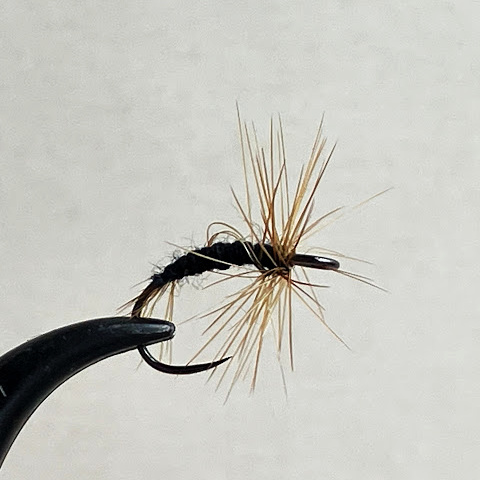
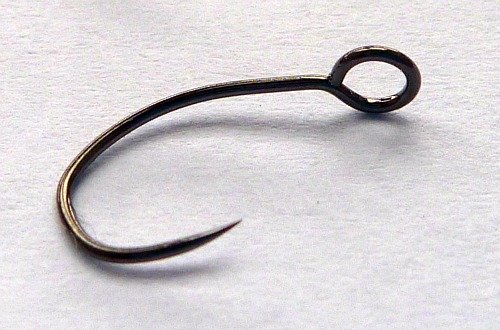 C'ultiva SBL-35 size 12
Wide-Eyed Hooks™ are available if you want to tie your own.
Step-by-steps
Most of the following flies are ones that I once offered for sale but I now offer only as step by step instructions.
Many of them would not be considered tenkara flies by Japanese anglers. I have fished them all with a tenkara rod and have caught fish. All of them work well when fished dead drift on a short line. For fishing a longer line or for a fly that is appropriate for manipulating, choose one of the hackled flies (not including the ones with starling hackle, which is quite mobile, but which provides little resistance in the water).
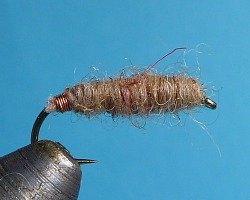
For years, most of the fish I caught with a tenkara rod were caught on a Killer Bug. I often wondered why I fished anything else. I have not adopted a "one fly" approach to tenkara and I doubt I ever will. The Killer Bug (or the Killer Kebari, which is essentially a Killer Bug with hackle; or a Killer Bugger, which is a Killer Bug with a marabou tail) certainly meets the requirements that Dr. Ishigaki set when he chose to become a "one fly" fisherman: it is simple to tie and it catches fish.
Over the years, though, I have come to realize that a fly with a bushy hackle resists being pulled through the water, and thus helps to keep your line tight and off the surface. I think that is why nearly all Japanese tenkara anglers fish hackled flies rather than nymphs (or Killer Bugs).
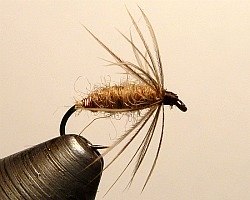
The Killer Kebari is the fly I tied for the first tenkara fly swap held in the US. Although the sakasa kebari is the best known tenkara fly in the US, most of the historical tenkara fly patterns in Japan were not reverse hackled. One of the Hida Takayama tenkara flies is just a fairly thick wool body with a soft hackle of hen or hen pheasant. That is about the perfect description of the fly you would get if you added a soft hackle to a killer bug. I've fished hackled killer bugs and have done well.
When I first tied the Killer Kebari, I wanted to incorporate the ultra-sparse hackle found in the North Country wet flies. To me, the sparse hackle just looks elegant. They do catch fish, but they do not provide noticeable resistance to being pulled through the water. They're fine for dead drifting on a short line, but for fishing with a longer line and active manipulation, I would replace the sparse soft hackle with a slightly fuller stiff hackle.
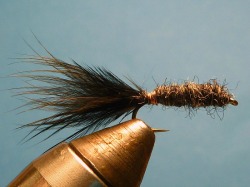
The Killer Bugger is a cross between a Killer Bug and a Woolly Bugger, basically just a Killer Bug with a marabou tail. The Woolly Bugger has proven itself everywhere, and the Killer Bugger has proven itself just about everywhere people have tried it.
Like the Killer Bug and Killer Kebari, it has little resistance to being pulled through the water. With a slimmer body and a palmered hackle, the fly would be a yarn bodied woolly bugger. It wouldn't be as simple to tie, but it would be more effective at keeping your line tight.
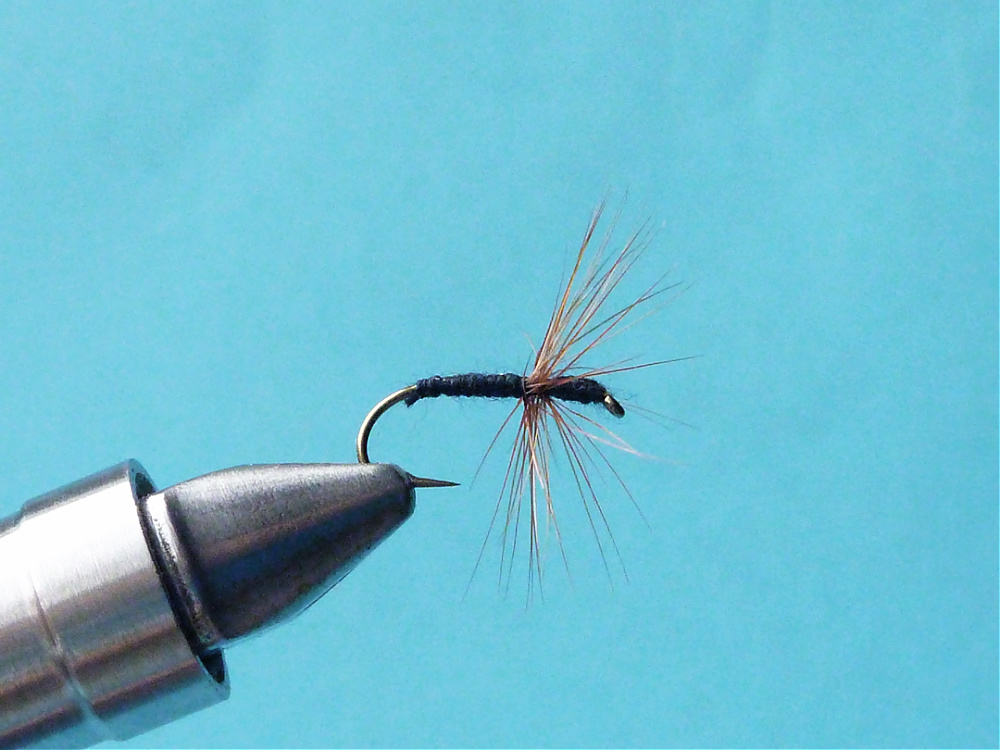
The simplicity of Dr. Ishigaki's sakasa kebari (reverse hackle) style tenkara fly is very attractive. It requires only two materials and is quick to tie. He calls it a kebari, but ever since he freely shared the pattern when he came to the US in 2009, everyone has called the pattern an Ishigaki Kebari.
When you consider that tenkara fishing in Japan is done in high-gradient mountain streams - not unlike many of our wild brookie streams - simple patterns make sense. In small mountain streams, fish do not have the luxury of closely examining their food. It goes by too fast. Fish in those conditions must eat quickly or not at all. If the pattern looks like it even might be food, and if the presentation is good, that's probably enough.
You will often see this fly tied with a soft hackle. Dr. Ishigaki uses rooster hackle, which provides more resistance in the water. Also, you will generally see this fly tied with a much more extreme sakasa shape (forward slanting hackle) than Dr. Ishigaki's own flies have. Further, you will often see it tied on curved shank hooks, which Dr. Ishigaki never does. I have revised the Ishigaki Kebari page to reflect, as closely as possible, the way Dr. Ishigaki himself ties the fly.
Tenkara USA claims a trademark on the name, even though they did not develop the pattern and the name was in the public sphere ever since Dr. Ishigaki made the recipe and instructions public in 2009.
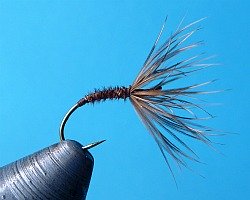
The Sakasa Kebari style of fly was developed with attention to presentation in mind. The reverse hackle, whether a soft hackle or a rooster neck, pulses when the angler tightens and loosens his line. This gives the fly the impression of life, and can be the most effective presentation you can achieve (and you can achieve it better with a long rod and light line).
Most people think that the fly is shaped the way it is because of that pulsing action. The sparse hackle on a British soft hackle will fold down along the hook shank when it is pulsed, while the sakasa kebari will open up.
I don't think that's the reason. I think it was chosen because if it is tied full rather than sparse it acts like a sea anchor or drogue chute (an underwater parachute). It resists the pull of the line, which reduces line sag. It allows a tenkara angler to keep a light line off the water's surface better. That reduces drag.
Interestingly, Japan is not the only place where you find such flies. In the Sesia valley in northern Italy, flies have been tied with reverse hackles for hundreds of years. And for hundreds of years, fishermen there used long rods with light lines tied to the rod tip.
Coincidence? I think not.
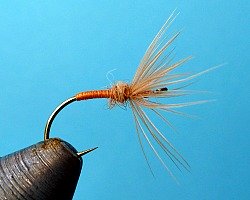
The Hen and Hound is a sakasa kebari style fly, but to me it is a special one. To some extent it is an outgrowth of Dr. Ishigaki's "one fly" approach, although my take was more of an "any fly" than THE ONE fly. I was in Colorado visiting my sister and decided to tie a few flies with the materials that were at hand: Ginger colored hackles from her hens and a bit of dubbing from her yellow Labrador Retriever. Orange silk thread to hold it all together (because that's what was already in the bobbin holder) and a barbless hook - required for Rocky Mountain National Park. I caught fish, and have tied more from time to time. The more I tie it, the better I like it.
One of the nice things about this fly is that the ginger hackle is pretty visible in the water, so you can often see the fly and see the take.
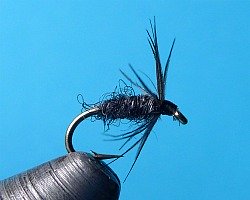
The Little Dark Kebari is actually a closer adaptation of the Hida Takayama style than is the Killer Kebari, which has already proven to be an effective and popular fly. The Little Dark Kebari is a bit smaller and darker, and may be taken by the trout to be a little black stone fly or little black caddis, or any one of the small, dark mayfly nymphs that make up a good percentage of a trout's diet.
I have done well with the fly, but it is a fly for fishing with a short line. The starling hackle is very soft, and provides almost no resistance in the water.
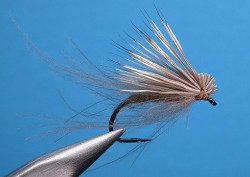
My second best fly, for several years running, was Hans Weilenmann's CDC & Elk, which is an elk hair caddis variation. For where I fish, the CDC & Elk is the only dry fly I feel I need. Fished dead drift or skittered, this fly draws strikes!
No one in Japan would consider it to be a "tenkara fly" but when tenkara was young in the US and when nearly all "hits" on Google were Japanese sites, more than a few sites showed fly boxes that held a few Elk Hair Caddis flies. "Inchiki tenkara" (fake tenkara) perhaps, they do catch fish and are easier to cast
than most dry flies because their delta wing shape produces less wind resistance.
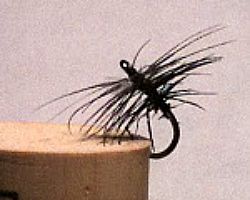
Although the Stewart Black Spider is not a "tenkara fly," it is an unweighted generic wet fly, one that does not try to match a specific hatch; one that you could have on your line all the time, as did WC Stewart. To me it perfectly fits with the simplicity of tenkara.
As with the Little Dark Kebari, the starling hackle provides almost no resistance to being pulled through the water. The hackle barbs fold back along the hook shank - which produces the profile of a swimming nymph. It is an effective fly, just perhaps not as effective for tenkara fishing as a traditional tenkara fly.
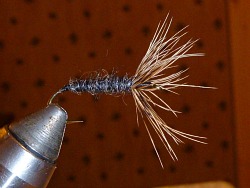
The Keeper Kebari is a yarn bodied sakasa kebari tied on a size 6 Daiichi 1560 nymph hook. It is a much smaller modification of the huge flies Sakakibara san tied for me on my first visit to Japan. Although a larger fly than most tenkara anglers use, it's not too large for trout and not too small
for bass. Sunfish take them easily (and
readily). What was most surprising was how confidently the fish take the fly, with no hesitation. I've had trout in particular hit the fly as soon as it hit the water, and it has proven to be the best fly for bass that I have ever used.
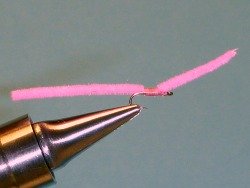
No one would say this is a tenkara fly. The Pink Chenille Worm is a variation of the San Juan worm, tied small and with a small hook. It is very simple, very cheap and very effective.
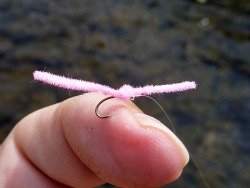
The Overhand Worm is even simpler than the Pink Chenille Worm. It needs no vise, no tools other than scissors or nippers, and no thread. You can tie it while on the stream and it takes only seconds to tie. Best of all, it is an extremely effective fly.
And it doesn't get any simpler. Even Morgan Lyle, author of Simple Flies was surprised by it.
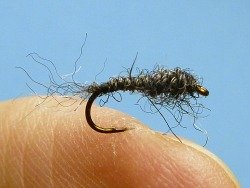
The Yarn Nymph is a simple unweighted nymph for when fish are taking nymphs high in the water column (when you see swirls just under the surface, but no bugs on the surface and no emergers actually emerging).
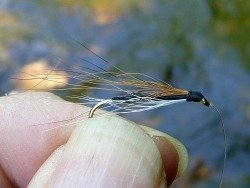
The Minimal Dace is the simplest fly I could devise to mimic the brown over black over white color pattern of the blacknose dace and the many other small fish that look about the same.
This fly is much easier to tie than Art Flick's Blacknose Dace and requires fewer materials. It also catches fish.
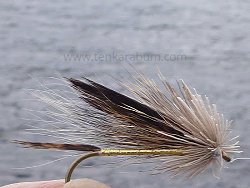
A Muddler Minnow is an excellent fly for bass and large trout. It is neither too large nor too wind resistant to cast with tenkara or keiryu rods.
I much prefer to tie the fly in the syle that Don Gapen, the originator, tied it: with a head the is neither tightly packed nor closely cropped. Once the deer hair is thoroughly soaked, the fly sinks and more closely imitates a sculpin, as Gapen intended.
Other "Tenkara" Fly Essays
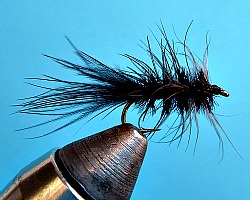
I'm a little surprised none of the "one fly" adherents have declared that their one fly is the woolly bugger. It has to be one of the most productive flies ever developed. Although a woolly bugger is often tied large and heavily weighted, a "tenkara woolly bugger" should be relatively small and unweighted. This one is tied on a size 12 nymph hook, with black marabou, black ostrich herl and a starling feather.
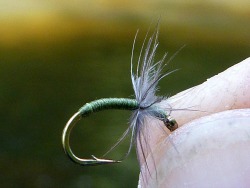
The 60s Rocker Sakasa Kebari is an adaptation of Ashley Valentine's shocking (and shockingly effective) Punk Rock Sakasa Kebari. Named 60s Rocker because it looks a rock star from the 60s whose once luxuriant hair has gone wispy and gray, and whose face now looks kind of green, this is the fly to tie if you're out of purple starling.
This is another fly that I have found to be quite effective - but only with a short line, dead drift presentation.
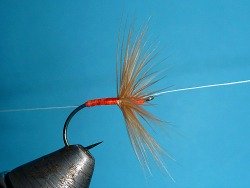
The Indicator Kebari is tied to use as a strike indicator. It is tied around the tippet as shown in the photo to the right or with a loop of mono (or silk bead cord) as a "tail" to which tippet to a second fly can be tied. It is a wet fly but it is kept at the surface by fishing with a relatively short, tight line. Bright and highly visible, it will clearly indicate strikes on the point fly while drawing a few strikes itself. And unlike most floating indicators, this one has a hook in it!
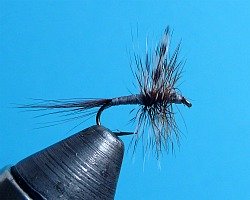
A Tenkara Rod with Western Flies works very well. Don't think for a minute that you have to give up what you have used successfully for years. If you are a hatch matcher from way back, you can still match the hatch with a tenkara rod.
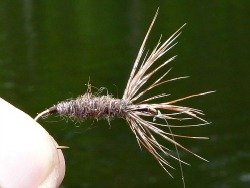
Tenkara Flies for Bass? Sure!
In Japan, tenkara is used only in mountain streams and only for trout. (Other than by a very few misfits who insist on using tenkara rods for chubs and dace, or even in salt water.) In the US, there are more misfits who are actively pushing the envelope and using tenkara rods in other waters and for other species. Bass and bluegills immediately come to mind. Purists proclaim that tenkara is only for trout and only in mountain streams. Misfits don't care.
Of all the tenkara flies I have used when fishing for bass, the best, by far, was a Keeper Kebari - tied with a wool yarn body and large partridge or pheasant hackle. The fly shown is tied with Jamieson's Shetland Spindrift "Moorit/Shaela" yarn and partridge. I've had equal success with the Jamieson's Shetland Spindrift "Oxford" Yarn and hen pheasant breast hackle.
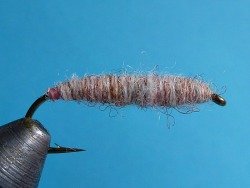
Crane fly larvae get big - up to two or three inches long. The Utah Killer Crane Fly shown here is tied on a size 6 Daiichi 1560, which is a 1 xl hook. Compared to the real thing it is still a bit on the small side, at about an inch. Still, it is a meaty mouthfull meant to tempt a hungry trout.
A size 6 fly with a yarn body, which will absorb water, will get heavy. The one pictured will be even heavier, as it has 10 wraps of lead wire. I wouldn't fish it with traditional tenkara rods, which were designed to fish unweighted wet flies. For a stiffer keiryu rod, like the Daiwa Keiryu-X series, it wouldn't be a problem.
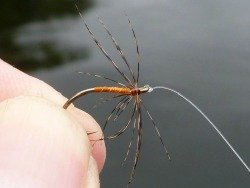
Elegant flies are simple. Not all simple flies are elegant. The classic Partridge & Orange North Country wet fly is elegant. It is also extremely simple, consisting of nothing more than a silk thread body and a turn or two of partridge hackle. It is another short line fly, but it is pretty (and pretty effective).
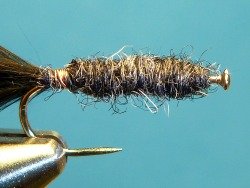
Bent Pin flies may be the polar opposite of elegant flies. We know that tenkara flies were once tied on needles that were reworked into fish hooks. You can do that but it is so much easier to just bend a pin. I've caught fish on flies tied on bent pins for years. So far, not one has gotten away by straightening the pin. I haven't hooked any really big fish with one, though.
Contests
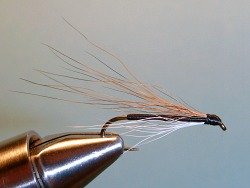
The TenkaraBum Streamer Challenge was to fish with streamers and bucktails. I don't know how many times I have heard (from someone who has never fished with a tenkara rod) that you can't fish streamers with a tenkara rod. The results from the challenge proved that not only that you can fish streamers with a fixed line rod, you can do so very effectively. You cannot "strip" the line as you do with a fly rod, but by rhythmically pulsing the rod tip, either upwards or held to the side, you can entice strikes.
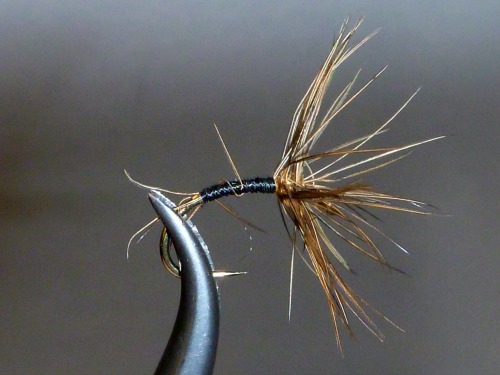
The goal of the TenkaraBum No Vise Challenge was to show people who don't currently tie their own flies that they don't have to be intimidated by which vise to buy and what special tools are needed. The challenge showed that very effective flies can be tied with nothing more than the clamps and nippers you already have and take to the stream every day. The flies won't win any contests (except for this one!), but the fish are the only judges that matter, and unsurprisingly (at least to me) the fish approved. Perfectly tied flies catch fishermen. Scruffy flies catch fish.
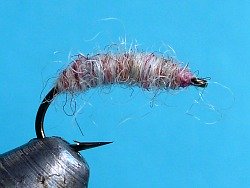
The Utah Killer Bug Challenge was co-sponsored by the Appalachian Tenkara Anglers Facebook Group, Tenkara Guides LLC in Salt Lake City, UT and TenkaraBum.com. Prizes were awarded for largest fish, smallest fish, most fish, and most fish species caught with a Utah Killer Bug (a Killer Bug tied with Jamieson's Shetland Spindrift "Oyster" yarn).
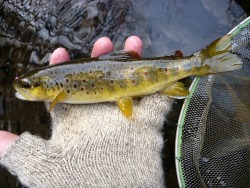
The TenkaraBum Winter Challenge took the "20-20 club" (catching a 20" fish on a size 20 fly) to a new level. Limited to flies size 20 and smaller, anglers got points for the length of the fish in inches plus the size of the hook. Thus, a 20" fish on a size 20 hook scored 40 points, but a 15" fish on a size 30 hook scored 45 points.
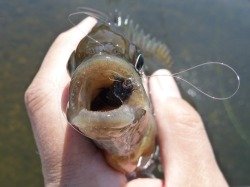
The TenkaraBum Challenge 2014 stemmed from the comment "You can catch anything with a black woolly bugger."
The fly at the center of Challenge wasn't a woolly bugger, but a Killer Bugger - which is a cross between a Killer Bug and a Woolly Bugger - basically a Killer Bug with a marabou tail.
The TenkaraBum Challenge 2014 was a species contest. The winner caught 23 species on a Black Killer Bugger, and among all contestants, 53 species of fish were caught.
So, what can YOU catch with a Black Killer Bugger?
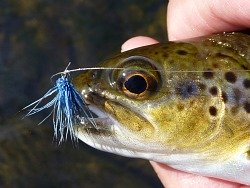
The Blue Fly Challenge was a fly tying contest judged by the fish. All that mattered was that the fly was predominantly blue, included at least some of the TenkaraBum Blue Fly Yarn, and caught fish. Prizes were awarded for first fish, largest fish (a rainbow trout estimated at 6-7 lbs), smallest fish (an eastern mosquitofish that almost fit on a penny) and most fish.
(I do remember that the "Blue Fly" yarn was a Jamieson's Shetland Spindrift color, but I
do not remember the real name of it. I think it was "Lunar," but it doesn't really matter. It was bright blue and if it weren't for the contest, NO ONE would have used it.)
TenkaraBum Home > Tenkara Flies
“The bitterness of poor quality remains long after the sweetness of low price is forgotten” - Benjamin Franklin
"Be sure in casting, that your fly fall first into the water, for if the line fall first, it scares or frightens the fish..." -
Col. Robert Venables 1662
As age slows my pace, I will become more like the heron.
We've all had situations where seriously chewed up flies kept catching fish after fish after fish. It is no sin to tie flies that come off the vise looking seriously chewed up.
Warning:
The hooks are sharp.
The coffee's hot.
The fish are slippery when wet.
Beware of the Dogma
Seriously, all the hooks sold on TenkaraBum.com, whether packaged as loose hooks or incorporated into flies, are sharp - or as Daiichi says on their hook packages, Dangerously Sharp. Some have barbs, which make removal from skin, eyes or clothing difficult. Wear eye protection. Wear a broad-brimmed hat. If you fish with or around children, bend down all hook barbs and make sure the children wear eye protection and broad-brimmed hats. Be aware of your back cast so no one gets hooked.
Also, all the rods sold on TenkaraBum.com will conduct electricity. Do not, under any circumstances, fish during a thunder storm. Consider any fishing rod to be a lightning rod! Fishing rods can and do get hit by lightning!


What's in stock?
Kurenai II AR 30F
Kurenai II AR 33F
Kurenai II AR 39F
TenkaraBum 33
Furaibo TF39
Furaibo TF39TA
Nissin Oni Tenkara Line
Thank you for all you do in posting education material on your site. After years of being intimidated by fly-tying, I read your articles and figured I would give it a shot.
Spent last weekend catching rainbows with my 4m rod and flies I had tied myself. It was incredibly gratifying, and I have you to thank for it.
T I, California
I’ve become an avid tyer and it started with your instruction. Chris I am deeply grateful, tying has brought me much joy.
Ernest Q, Maine
If you enjoy spin fishing or baitcasting please visit my sister site Finesse-Fishing.com.