I'm sure it has been clear to everyone that I have been winding down the TenkaraBum and Finesse-Fishing sites for a while now. There is very little left in stock - just three tenkara rods and some lines on the TenkaraBum site and just five spinning rods, some lines and some ultralight spinners and spoons on the Finesse-Fishing site.
I will be taking a step closer to retirement beginning November 11. I will be away from the shop for a month. Not a fishing trip, not a business trip, not a vacation. Instead, more of a temporary or "practice" retirement. While I am away, you can purchase anything that is in stock but it won't get shipped until December 11 or shortly thereafter. If you are quick, I can ship items on November 9 and 10.
While I am away from the shop I will not be able to sell any replacement parts that may be in stock but not on the website, and will not be able to order any parts that are not in stock. If you need a replacement part, I would suggest contacting Keiichi Okushi, who owns Tenkara-ya in Japan. Google can find the email address for you.
I do not plan on even reading emails, let alone answering them. There are a number of other fine tenkara shops in the US who can answer urgent questions or provide immediate shipment for any gear you may need right away.
I will be back, but until then, take care (and don't break anything).
Utah Killer Crane Fly
The inspiration for the Utah Killer Crane Fly was a video on Midcurrent showing a crane fly larva being tied using the Utah Killer Bug Yarn. Since the video was released, there has been a spike in interest in the Utah Killer Bug and Utah Killer Bug Yarn but also in tying crane fly larvae imitations.
Crane fly larvae get big - up to two or three inches long. In the video, the fly was tied on a size 12 3xl hook. The one shown here is tied on a size 6 Daiichi 1560, which is a 1 xl hook. Compared to the real thing it is still a bit on the small side, at about an inch. Still, it is a meaty mouthfull meant to tempt a hungry trout.
A size 6 fly with a yarn body, which will absorb water, will get heavy. The one pictured will be even heavier, as it has 10 wraps of lead wire. It really is a bit much for traditional tenkara rods, which after all, were designed to fish unweighted wet flies. For a nontraditional rod, like the Daiwa Kiyose SF series, that isn't a problem.

First Trial
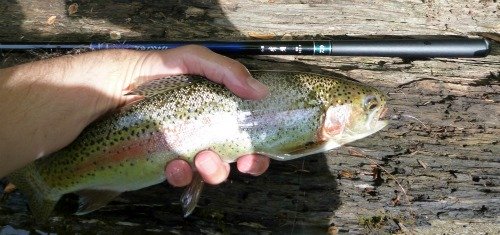 First fish on Utah Killer Crane Fly - 14.5" Rainbow
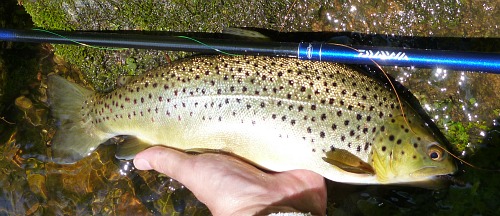 Third fish on Utah Killer Crane Fly - 15" Brown
The Rod
The rod I used for this trial is the Daiwa Kiyose 30SF, which is a relatively stiff 10' rod. The fish put a good bend in the rod, to be sure, but I did not feel it was anywhere close to its limits.
The Kiyose is a stiff rod, but that is what you need to fish heavy nymphs deep in current. The average tenkara rod is much too soft, particularly in the tip sections, to give you reliable hook sets if you are fishing in the bottom few inches of the water column rather than the top few inches.
I'd say both the Kiyose and the heavy Utah Killer Crane Fly performed beautifully together.
I no longer carry the Kiyose 30SF. I have replaced the SF series with the very similar but newer Daiwa Keiryu-X rods.
TenkaraBum Home > Tenkara Flies > Utah Killer Crane Fly
“The bitterness of poor quality remains long after the sweetness of low price is forgotten” - Benjamin Franklin
"Be sure in casting, that your fly fall first into the water, for if the line fall first, it scares or frightens the fish..." -
Col. Robert Venables 1662
As age slows my pace, I will become more like the heron.
We've all had situations where seriously chewed up flies kept catching fish after fish after fish. It is no sin to tie flies that come off the vise looking seriously chewed up.
Warning:
The hooks are sharp.
The coffee's hot.
The fish are slippery when wet.
Beware of the Dogma
All the hooks sold on TenkaraBum.com, whether packaged as loose hooks or incorporated into flies, are sharp - or as Daiichi says on their hook packages, Dangerously Sharp. Some have barbs, which make removal from skin, eyes or clothing difficult. Wear eye protection. Wear a broad-brimmed hat. If you fish with or around children, bend down all hook barbs and make sure the children wear eye protection and broad-brimmed hats. Pay attention to your back cast so no one gets hooked.
Also, all the rods sold on TenkaraBum.com will conduct electricity. Do not, under any circumstances, fish during a thunder storm. Consider any fishing rod to be a lightning rod! Fishing rods can and do get hit by lightning!


