Daiwa Enshou Tenkara Rods
The Daiwa Enshou rods were discontinued long enough ago that the Expert rods that replaced them also have been discontinued. Daiwa now has a second generation Expert rod that I have not seen and know nothing about.
Early on, I imported Daiwa Neo Tenkara rods, but the ones I imported were replaced by a new generation of Neo Tenkara rods that I have not seen.
The first Daiwa rod I got was the LL41SF (their Level Line 4.1 meter SF series rod). What an eye opener! By the time I'd gotten it, I had owned and fished with all of the Tenkara USA rods and all the Fountainhead rods. The Daiwa was on a completely different level - both in overall quality and in feel. It wasn't long until I'd bought all of the Enshou models (two models for level lines and four for level or tapered lines). It wasn't long after that that I decided to import them. [The Daiwa Enshou level line models have been discontinued and have been replaced by the new Daiwa Expert L models.]
Back in early 2012, it was a leap of faith that the US tenkara market was ready for $300+ tenkara rods, but I was convinced that once people tried them they would agree that the Daiwas really were premium rods and well worth the premium price. Most of the people who buy tenkara rods already have a number of fly rods and for most anglers, $300 is modest for a fly rod. Considering that you don't need to buy a matching reel or an expensive line to go with it, the overall outlay is a lot less than adding one more fly rod.
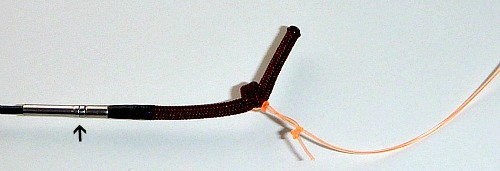 Micro swivel attachment reduces line twist.
The lillian (the short bit of cord to which the line is tied) is attached to the rod with a micro swivel. Most tenkara rods don't have them because it is cheaper to make rods without them.
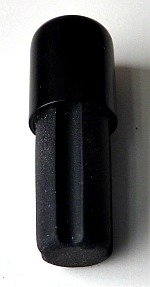 |
The tip plug is wood and rubber, and has a very snug fit. It will never fall out by itself, as happens with the plugs on many other rods. One of the very nice design features of the rod is the fluting in the rubber part of the plug (left photo). This fluting is easily large enough to insert the plug when the rod is collapsed with the line still attached. |
 |
Inserting the tip plug when the rod is collapsed - whether to walk along a streamside trail or to drive to a new spot, or when carrying a second rod in a backpack is highly recommended. I know of rods that have been broken in each of those three situations - and in each situation, having a the tip plug in the rod would have prevented the breakage
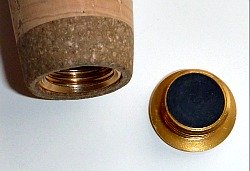
The screw cap at the end of the grip section on Daiwa tenkara rods screws into a metal fitting, but the flange tightens against the cork grip, which produces the same result as a rubber washer would. It snugs up and stays put. To tighten or loosen the screw, there is a slot into which a quarter fits nicely. In the unlikely event that the cap is loose, you can hear the rattle of the loose threads so you have a warning to tighten it before it is lost. (And if by chance you do happen to lose it or the tip plug, replacements are available.) The inside end of the screw has a rubber insert so there isn't the annoying clicking sound of rod sections hitting the screw when the rod is collapsed.
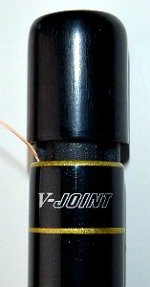
The Enshou series has what Daiwa calls a "V Joint." The end of each section where it snugs up inside of the next larger one has rings machined into it. This does two things. First, it allows the joint to flex more, minimizing the "dead spots" of the rod curve at the joints where two sections overlap. The second thing the machined rings do is make it much less likely that you will ever get a stuck section. The sections seat easily when extending the rod. When it comes time to collapse the rod, they give way just as easily.
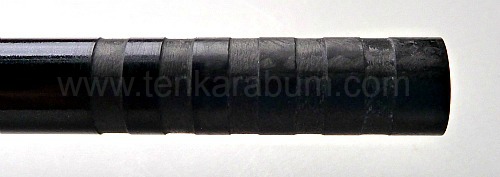
After having fished with dozens of different rods, and after having extended and collapsed hundreds, I really do appreciate the "V Joint." It's one of those design elements that you don't see. The joint is completely hidden whether the rod is collapsed or extended. They're obviously not "for show." They're there because they make the rod better, and the Daiwa tenkara rods are the only ones that have them.
Another feature that isn't obvious but that I certainly appreciate is the very slight reinforcement - a thickening of the blank right at the junction between sections. I've seen rods break right where a section exits from the next larger section, but never a Daiwa. The slight reinforcement strengthens the area, makes it easier to seat the sections with the proper degree of "snugness" and also makes the sections easier to collapse.
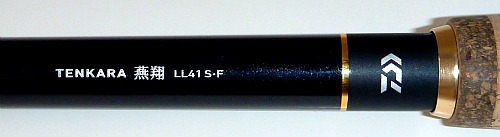 The finish on the Enshou Daiwa tenkara rods looks black, but has minute blue flecks.
With some rods it is hard to tell how tight is tight enough. Not with Daiwa tenkara rods. It's a little hard to describe the feel of how you'll know, but you'll know. It is just one more of the little things that taken by itself isn't so significant, but when combined with all the other "little things" truly do make the rod a better piece of engineering. You can really tell that the rod designers actually designed the rod. These are definitely not off-the-shelf-with-a-few-tweaks-and-a-new-paint-job-rods!
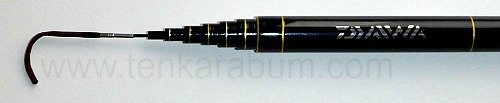
And speaking of the paint job, the finish is almost black but in the right light you can see minute blue specks in it. There's not much ornamentation, with a stylized "D" near the winding check, narrow gold bands at the end of the segments, and the stylized Daiwa logo at the end of the grip section. Daiwa tenkara rods just look classy. Understated elegance.
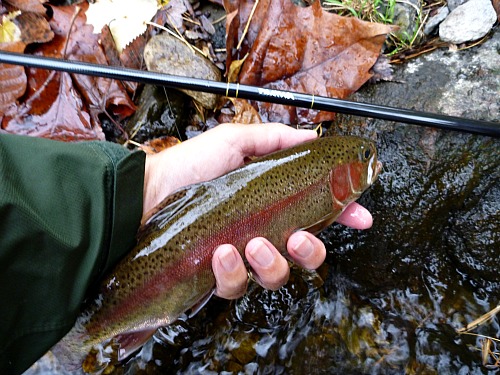
The Daiwa tenkara rods designed for level or tapered lines (LT) are 7:3 rods. They really illustrate what I've said all along: the rating is a measure of where the rod bends, not a measure of how stiff the rod is. They have a very gradual transition from the softer tip sections to the stiffer mid and butt sections. The casting stroke is remarkably smooth. They're tip action rods, not stiff action rods.
The LT39SF had been the most popular of the Daiwa tenkara rods, and it seems most buyers chose it to replace their Amago. Relative to the Amago, it is a bit shorter but is also noticeably lighter in the hand and feels much lighter when casting. The LT39SF is very slightly softer in the butt section but stiffer in the tip section. The slightly stiffer tip would help when casting wind resistant flies or when fishing weighted nymphs.
Without doubt, the Daiwa Enshou LT39SF was one of the best rods to consider if you expect to catch larger fish.
As with all the other Japanese rods, the Daiwa tenkara rods do not come with a hard rod case. The Enshou rods do come with a limited warranty but warranties do not feature highly in Japanese anglers' decisions on what rods to buy. They buy quality, not warranty.
Replacement parts are available for all the Daiwa tenkara rods, although very few of my customers have needed them.
Recommended lines: I would recommend a size 3.5 Hi-Vis level line.
The weights given above are the official weights from Daiwa. Across the board, they are heavier than the weights I get on my postal scale. I weighed rods without the tip plug because the plug is not in the rod when fishing.
TenkaraBum Home> Tenkara Rods> Daiwa Tenkara Rods
“The bitterness of poor quality remains long after the sweetness of low price is forgotten” - Benjamin Franklin
"Be sure in casting, that your fly fall first into the water, for if the line fall first, it scares or frightens the fish..." -
Col. Robert Venables 1662
As age slows my pace, I will become more like the heron.
Warning:
The hooks are sharp.
The coffee's hot.
The fish are slippery when wet.
Beware of the Dogma



|
I have the LT44SF and also a couple of 7:3 and 8:2 long rods (the Bow River is big and I find I need a longer line - 6.5 to 8.0 meters). The LT44SF rod is the best of the lot, easily casts longer and heavier furled lines, easily casts bead head soft hackles. Just remember to slow down your casting. Lots of power to land 16" plus fish but very smooth in the hand and bouncy enough to protect 6x tippet. Definitely one of the better rods I have in my stable. James B, Alberta |
| DAIWA LT36SF - I note the smooth transition from tip sections to butt sections. I like that very much.
Marie P, Italy |
| Long story short - where I tied into the first bigguns I hooked another. The Daiwa was an entire different
story. This time when the fish took a bull run down river I didn't give it a chance to break off. The rod is something else. I was drifting down river with the trout in front of me. It tired and I was able to turn it. I actually got to see the fish really no idea how big. Using barbless hook. Got net close it pulled off - didn't break me off. What a kick and rush. That rod is incredible. I was totally amazed in the precise and accurate casting of that rod. Handles like a dream. Didn't really care about netting fish. Just hooking was a HOOT! My western setup has gone into retirement! Okay, how I see it, if you are going to chase BIG fish, use a rod that can handle them. I'm going to make a rather harsh statement now: if you compare the Amago to the LT44 - sorry - the Amago is a toy and not really worth much. NO comparison in the quality and casting of the two. I am going to sell or give away both my Tenkara USA rods. Dave H, Wyoming |
| What a sweet rod. The LT39SF handled all the casts I threw today, and it's proven to be a very accurate rod. I was putting flies in some really tight lanes, and I started whacking the fish. It really was one of those days.
When the other fishermen asked me "have you caught any fish?" I just said "Yeah, I've caught a few." They definitely would have thought I was BSing them if I told them the truth. It makes me want to run right back up the mountain again. Thanks for bringing the Daiwas to us Chris. I didn't think tenkara could get any better but it just did. Jeff S, California |
| Used the new rod [LL36SF] after lunch and it was a joy. Your description was exactly right - much lighter and could cast more accurately.
William H, Georgia |
| The quality of the Daiwa rods is impressive.
Dan S, Michigan |
| ...decided to "start from scratch", following your recommendations exactly. That meant putting away the furled lines, along with the RIG floating lines. It also meant getting out the LL41SF which you so highly recommended. I'd tried it a few times after receiving it and sort of shrugged - "It's nice enough, I suppose."
The short version is that using it as you recommended - as opposed to using it as I insisted - proved it to be as perfect a fishing pole as I have ever tried, and I just felt the need to thank you for suggesting it and for pointing the way. Noel S, California |
| Starting in November the tenkara fishing has been wonderful-first time out my two old friends laughed at the Daiwa [LL36SF] and over next two hours I landed over 20 trout (Nantahala stocked) and the two of them landed 3. At lunch they complained it was "unsporting"-geez. Everything has worked perfect the net, fly patterns and technique. Saturday morning I hooked a plus 20" rainbow and landed on Daiwa-and forgot the net! Once again thank you.
Bill H, Georgia |
| The Daiwa LT39SF remains a go-to rod for me when chasing trout around the 20-25 inch mark.
Rob W, Kentucky |
If you enjoy spin fishing or baitcasting please visit my sister site Finesse-Fishing.com.