Daiwa Kiyose SF Series
Backpacking Rod / Nymphing Rod
Backpacking Rod
The Daiwa Kiyose is sold in Japan as a rod to keep in a travel bag or daypack for fishing mountain streams, lakes or even the ocean. It is particularly well suited for people who want a light weight, compact rod for backpacking.
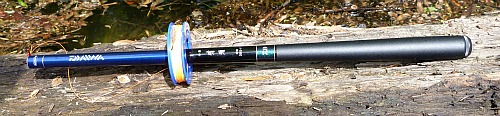
Not long after tenkara was introduced into the US it became pretty clear that tenkara and backpacking go together very well. Tenkara rods are light weight, they collapse to a manageable length, and best of all, they do away with the reel - the heaviest and bulkiest part of a backpacker's fishing kit.
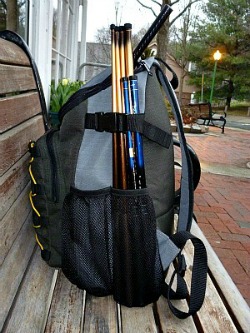
Fortunately for ultralight backpackers, for whom a meal of fresh fish on the trail provides not only needed calories and protein but also a welcome relief from freeze-dried food, there are rods that are particularly well suited their needs.
Considering its light weight (2.4 ounces), compact size (15.6" collapsed), effectiveness and modest cost, you'll have a hard time finding a rod better suited for backpacking than the Daiwa Kiyose 33SF.
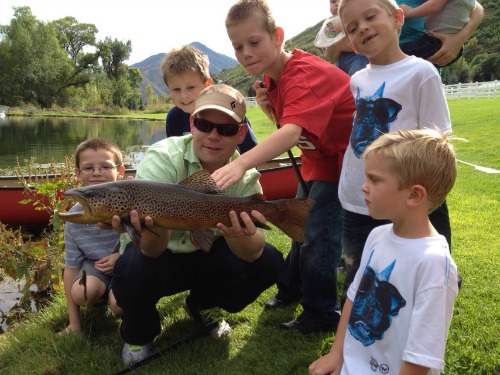
The 26 inch brown trout below was caught with a Kiyose 33SF using 6X tippet. The Daiwa designers did a masterful job in creating a rod that not only has the backbone to handle larger fish, but also the ability to do it while still protecting a light tippet.
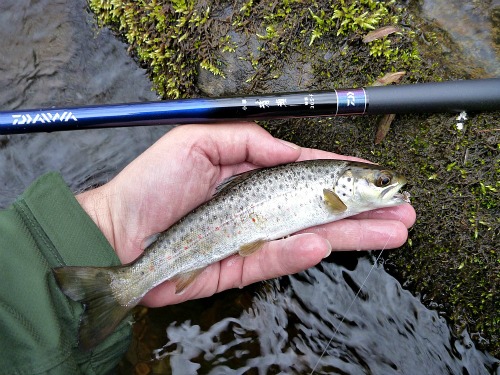
With a relatively short line, you can dance a CDC & Elk across the pockets of a headwaters stream, drift an Adams alongside an undercut bank or twitch a sakasa kebari through a plunge pool. You can fish it just the same way you would fish any tenkara rod.
And just because they can handle a 26 inch brown, don't think it isn't any fun to catch more modest fish. An 8 incher will still put a bend in the rod.
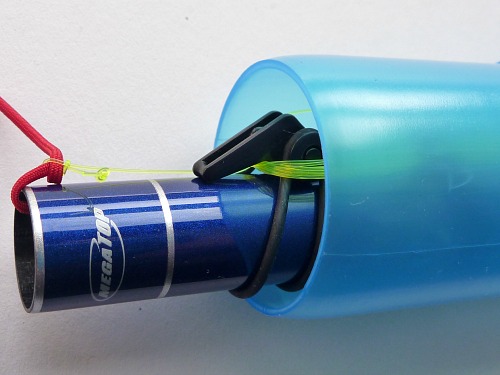
The Kiyose 30SF, with a pair of Fuji EZ Keepers attached as shown in the photo above, will fit in the Small Rod Case. You can keep the fully rigged rod in your backpack and the case keeps other things in your pack from getting caught in the attached line, while at the same time protecting the rod and. It doesn't get much more convenient than that.
It's not just a backpacking rod, though. The rod really shines when you tie on a bulky hopper or a heavy beadhead nymph - things people want to do with tenkara rods, but tenkara rods don't do particularly well.
Nymphing Rod
There has been a bit of a discussion recently about a tenkara rod as a tool and tenkara as a method. Tenkara rods and techniques evolved together over hundreds of years. Tenkara, the method, is generally considered to be fishing a single unweighted wet fly. Tenkara rods, the tools, are superb for that purpose. The further you get from a single unweighted wet fly, though, the less superb a tenkara rod becomes.
About the same time that American anglers decided tenkara rods would be great for backpacking, they also decided they would be great for Czech nymphing. After all, even though Czech nymphing is done with a rod and reel, the reel is only used to store all the line you don't need when Czech nymphing. On the surface, it would seem that a tenkara rod would be ideal. As it turns out, on the surface a tenkara rod really is ideal, but near the bottom, where you are fishing your Czech nymphs, not so much.
Just as a longer rod is a benefit in tenkara fishing, it is also a benefit in Euronymphing (any of the Czech, Polish, Spanish, French styles). Euronymphers now routinely use 10' rods.
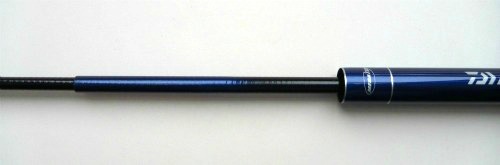
There is more to a Euronymphing rod than 10' and a reel seat, though. I once asked Aaron Jasper, who has made a name for himself in Euronymphing and has a couple Euronymphing DVDs out, if he had ever tried a tenkara rod. He said he had but didn't like it for Euronymphing. It was too soft. I was not at all surprised by his answer, as I had already come to the same conclusion.
There are people who use tenkara rods for Czech nymphing (and Spanish and French etc.) and who claim they work very well. Certainly you can do it, but a couple heavy nymphs, particularly in strong current, are far enough away from a single wet fly fished just a few inches below the surface that a tenkara rod is no longer the best rod for the job.
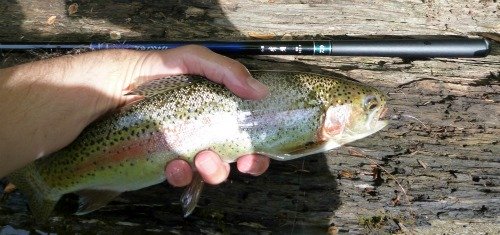
The tenkara rod that is soft enough to cast an extremely light line is too soft to reliably hook fish two or three feet below the surface, particularly if there is much current. For that you need a stiffer rod - or you need an overly aggressive hookset - which has been known to break tenkara rods. And the guys who advocate using tenkara rods for Czech nymphing? Ask them how many tenkara rods they've broken. You would be shocked. (As an update, now that they've had some time fishing with keiryu rods, they no longer recommend tenkara rods for Czech nymphing!)
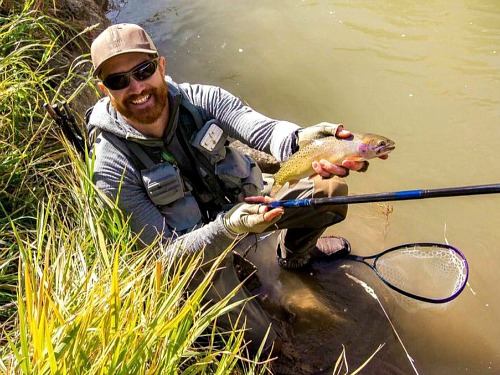 ERiK Ostrander of the Tenkara Guides
Czech nymphing with a Daiwa Kiyose SF
Joel Hitsman photo
Please understand that the above comment does not in any way imply that any particular tenkara rod is likely to break when it is used for the purpose for which it was designed. It was meant to imply - no, to directly state - that tenkara rods were not designed for fishing heavy flies, with or without heavy current.
The Daiwa Kiyose SF rods are stiffer than traditional tenkara rods and notably have a stiffer tip section. They are thus a better choice for fishing heavy nymphs.
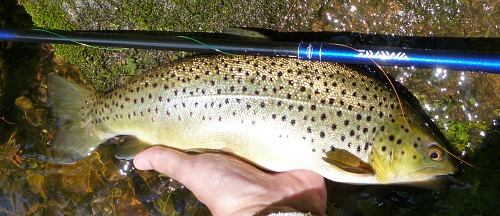 Brown trout caught with the Daiwa Kiyose 30SF on a large,
very heavily weighted fly.
People don't talk about it much, but long rods are great for fishing streamers (or bucktails or buggers). I suspect the main reason they don't talk about it much is because it isn't done in Japan. Is there that much difference between pulsing a streamer and pulsing a kebari?
That all depends on how big your streamer is and how deep you fish it. If you "huck big ugly streamers" like Erik Ostrander does, then yes, there is a difference - a big difference. First, there is a substantial difference in the water resistance you get from a size 12 soft hackled kebari and a big ugly streamer. Plus, if you add any weight at all to your bugger or sculpin to get it down where the lunkers lurk, you are going to need a rod with a stiffer tip and midsection than you'll find on any tenkara rod.
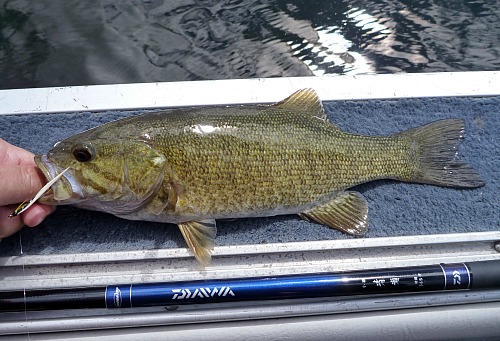
The Daiwa Kiyose SF series rod tips have the stiffness you'd need - not only to manipulate your streamer or bugger or sculpin but to set the hook when it gets hit. There's no point discovering a fun way to fish a fixed line rod if it can't handle the hook set. I've seen one tenkara rod break on a hook set and know of others. They're not designed for fishing deep. Keiryu rods are.
Daiwa Kiyose SF Features
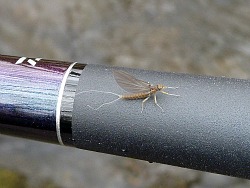
The first thing you'll notice about a Daiwa Kiyose SF rod, even before how good looking it is in the sunlight, is that the grip is relatively narrow and has no cork. I have now fished with a lot of tenkara rods, most with cork grips, a couple with wooden grips. I do not find the lack of cork or the narrow diameter to be any problem at all. I also use a more open grip. The 30SF rod weighs less than two ounces. It is so light that you don't need any cushioning and you don't have to hold it tightly. Plus it has a very effective non-skid coating. By the time you get up to the 42SF, the grip is no longer narrow. It gives you just about the grip you'd want for a big, beefy rod.
Please note: Fuji EZ Keepers will not fit on the Daiwa Kiyose 39SF or 42SF. I would recommend a pair of the Small Tenkara Line Holders instead.
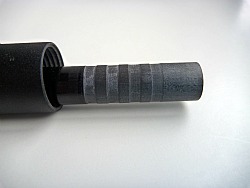
Like the Daiwa high end tenkara rods, the Daiwa Kiyose SF has rings machined into the blank at the joints. The "V Joint" as Daiwa calls it, serves two functions. It produces a smoother curve over the length of the rod, reducing the hard spots where there are two layers of tubing at the joints. Perhaps more important, though, the V Joint significantly reduces the chances of getting a stuck section.
It really does! I received a comment from an angler who had a Daiwa Kiyose SF rod and a Shimano Kozuka NT rod (a very similar rod, since discontinued). He said the Kiyose was consistently much easier to collapse.
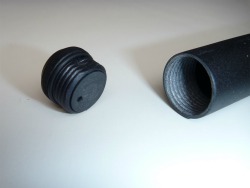
The Daiwa Kiyose SF grip cap has a rubber core so there is no annoying click-clack of the collapsed sections as you walk down the trial. It has a rubber "O" ring washer so it snugs down tight and does not loosen while you are on the stream. It also has a ventilation hole to allow the rod to dry out between trips. (I'd still take the rod apart to let it dry thoroughly.)
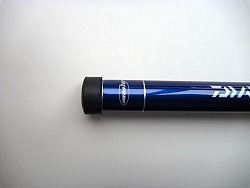
The Daiwa Kiyose SF has a rubber tip plug. The Kiyose's tip plug does
not have fluting, but it also does not have an extremely snug fit so you
can still insert the plug with a level line still attached. As with all
tenkara rods, you will have to watch the tip plug to make sure it
doesn't get lost. If by chance it does, however, replacements are
available. For that matter, replacement parts are available for any
piece that happens to get lost or broken.
All in all, the Daiwa
Kiyose is a pretty unique and well thought out rod. Backpackers and
nymph fishermen in particular will have a very hard time finding a rod
better suited to their needs. And for an ultralight backpacker who
primarily fishes heavy nymphs, there is no better rod.
The Daiwa Kiyose SF rods have done more to shake up tenkara fishing in the US than any other rod. Just as tenkara rods encouraged fly fishermen to break the fly fishing mold, the Kiyose rods encouraged anglers to break the tenkara fishing mold. They don't have cork grips. They don't have soft, whippy tips. They do fish heavy nymphs very effectively and they easily handle the larger fish you catch when you fish deep. They made people realize that a rod doesn't have to fit the narrow definition a "tenkara" rod to be simple, fun and effective. Similarly, your fishing style (weighted nymphs or big bulky flies) doesn't have to fit within a purist's definition of tenkara to be simple, fun and effective.
Model
Length
Collapsed
Wt oz
Sections
Tip mm
Butt mm
Carbon
Pennies
33 SF
10'10"
15.6"
2.2
11
.7
18.6
80%
34
Years ago (just before the 2016 election) I wrote an article entitled "Post-Apocalyptic Fishin' Kit." The centerpiece of the kit was a Daiwa Kiyose 30SF.
The article definitely was tongue in cheek, but the idea of having a sturdy rod that is easy to pack (even up your sleeve if need be) is just as valid today. The Daiwa Kiyose 33SF is about as easy to pack as most of the "backpacking" rods and is a lot more robust than just about any of them. You don't want to be halfway into a through hike and break a rod tip.
I've had the rod in inventory for years, held back so that I could quickly supply replacement parts if anyone needed them. Very few people needed them, though.
If you want to read the Post-Apocalyptic Fishin' Kit, you can find it here (copy and paste into a browser): https://web.archive.org/web/20161127112851/https://www.tenkarabum.com/post-apocalyptic-fishin-kit.html
Shipping
Domestic shipping will be $9.00 to a US address via USPS Ground Advantage (2-5 day delivery). International shipping charge will be higher.
Please note: All packages are shipped via USPS. If you have a PO Box, please list ONLY the PO Box in your address, not the PO Box and your street address.
Please do not put anything in the box for "Company" if it isn't absolutely necessary. Not "self", not "none" not "--", nothing. It wastes your time to put it in and it wastes my time to take it back out. Please just leave it blank.
International Shipments
International purchases may be subject to import duties and taxes. I cannot keep track of all import regulations in all countries written in all languages. Understanding and paying import duties and taxes is the responsibility of the buyer.
EU
TenkaraBum.com no longer ships to the EU.
Russia
TenkaraBum.com no longer ships to Russia.
UK
TenkaraBum.com no longer ships to the UK. The new VAT regulations are too onerous for a one-man shop that rarely ships anything to the UK anyway. I apologize.
TenkaraBum Home > Tenkara Rods > Daiwa Kiyose
“The bitterness of poor quality remains long after the sweetness of low price is forgotten” - Benjamin Franklin
"Be sure in casting, that your fly fall first into the water, for if the line fall first, it scares or frightens the fish..." -
Col. Robert Venables 1662
As age slows my pace, I will become more like the heron.
We've all had situations where seriously chewed up flies kept catching fish after fish after fish. It is no sin to tie flies that come off the vise looking seriously chewed up.
Warning:
The hooks are sharp.
The coffee's hot.
The fish are slippery when wet.
Beware of the Dogma
All the hooks sold on TenkaraBum.com, whether packaged as loose hooks or incorporated into flies, are sharp - or as Daiichi says on their hook packages, Dangerously Sharp. Some have barbs, which make removal from skin, eyes or clothing difficult. Wear eye protection. Wear a broad-brimmed hat. If you fish with or around children, bend down all hook barbs and make sure the children wear eye protection and broad-brimmed hats. Be aware of your back cast so no one gets hooked.
Also, all the rods sold on TenkaraBum.com will conduct electricity. Do not, under any circumstances, fish during a thunder storm. Consider any fishing rod to be a lightning rod! Fishing rods can and do get hit by lightning!


What's in stock?
Kurenai II AR 33F
Kurenai II AR 39F
Furaibo TF39
Furaibo TF39TA
Nissin Oni Tenkara Line
I finally got out to test the Kiyose. I tied on a 13' heavy tapered
leader you made for me, and about 3 feet of 5x tippet. Used a small
(size 12) parahopper, and a dark size 16 caddis and was surprised at how
easily the rod allowed me to get the two flies out onto the water. It
is an unexpected combination, being stiff enough to throw two flies
well, and yet being incredibly light.
I forgot my net (typical) and was worried that I'd have a hard time
landing a fish, but the fears were unjustified. I caught a 15” and a 17”
brown on the caddis, and an 18” rainbow on the hopper. All within 30
minutes. The rod worked flawlessly in fighting these larger fish.
Thanks for selling me this "non-tenkara" rod. It's a real gem.
Jim L, Colorado
I just got back from Vermont and the rod was great. I was able to fish
all the small pocket water for pure wild Vermont mountain creek brook
trout and had a blast, I lost count of the amount fish I caught.
The rod is truly amazing.
Keith A, New York
Can’t say enough about the 42SF ! I can definitely almost hook and
heard small farm animals with that stick. What a joy to nymph with in
larger rivers. Main advantage you have with this series, is the ability
for hook sets confidently in runs over 3ft deep – which is a plus since
some other Japanese rod Tenkara type models are softer in the upper 3
sections. This is fine for swinging and lighter nymphing – but when you
have a cork indo – a split w/ tungsten – and a 3 fly rig on the
Arkansas in Salida CO, the runs there are channelized, fast and can
average 6 feet in some places.
Ray R, Colorado
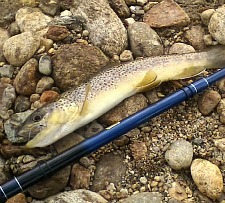
Hi Chris,
Here's a picture of my first tenkara Brown Trout taken in Rocky Mountain
National Park. Just a little over 12" but it felt & fought like a
two pounder.
Is it legal to have this much fun with a rod that weighs a couple of
ounces?
Thanks to you & Tenkara Bum for introducing an old retired guy to
fly fishing made easy!
Kind regards,
Robert T, Colorado
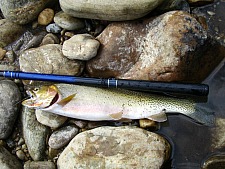
I have attached a photo from my Idaho trip in September. My estimate is
that the rod in the photo caught over 400 trout since I bought it this
past January.
Roy S, Pennsylvania
I keep a Diawa 36SF in my fishing daypack at all times because when the
wind is howling or it is time to go deep, this rod has no equal. And I
like how compact it is when collapsed.
John V, Utah
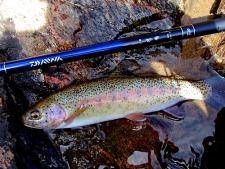
I just wanted to say how pleased I am with the Kiyose 33SF. It works
just as advertised (how about that). Thanks for selling this item, along
with the thorough explanation of its usefulness and features. Is it a
tenkara rod? Ha, I don't think the trout are judging me. Keep up the
good work.
Jeffrey D, Colorado
I
love the Daiwa Kiyose 39SF! Having used much softer rods, I was
surprised that the first fish I pulled in with it, a 14-inch Rainbow,
was way more fun than I thought it would be on a 38 penny rod. My wife
caught her first fish on a fly with it and now she’s “hooked,” too.
Jayson S, California
It's almost unbelievable how effective nymphing with this rod is over a fly rod. Bluegill,
rock bass, smallmouth, largemouth and trout; it's like picking carrots! The rod is extremely sensitive.
I highly recommend the 39SF. It's light enough for one handed casting
and great fun to fish. Oh, and it casts a size 4 fluoro level line very
well if you can tear yourself away from weighted nymphs to fish wets
and dries.
Thanks, Chris. Great rod!
Herb S, Michigan
The Diawa [33SF] is a very well thought out rod. It casts beautiful,
looks great, I think the rings around each segment make so much
difference in how smooth it casts. Small, looks great, only thing it's
missing is a swivel on the tip, price is great, strong rod, best bang
for the buck - hands down.
John P, Ohio
For big rivers and big fish I like to use keiryu rods. My current
favorites are the Daiwa 39SF, Daiwa 42SF, and Nissin 450ZX medium. I
can chuck big flies and land big fish in high flows.
Erik O, Utah
I just wanted to thank you for your excellent service on my recent
orders. Also, I wanted to give you a little product review on the Daiwa
Kiyose 33SF, which I ordered some weeks back. Most of my fishing is with
heavier nymphs in warm water. This past week I was able to take a
couple of dozen bluegills (including at least one or two eight-inchers)
from an area pond, plus a nice catfish. This rod makes an excellent
nymphing stick, with just the right stiffness and backbone. It offered
good hookset, while still allowing me plenty of fun with smaller-size,
warm water fish. I think the Daiwa Kiyose is a great rod for the kind of
fishing I do. I really like its build-quality as well.
John E, Texas
The 33SF is an excellent nymphing rod.
Alan L, Missouri
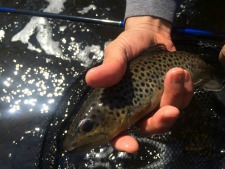
I purchased a nifty little rod from you in January at the Marlboro show in MA, a Kiyose 3.0
Hadn't had much chance to use it to its full extent as some streams were
too treed in and the rod too long or I was casting for distance…but
today, well this river was perfect nymph water, with mostly clear
overhead room. This little rod out fished a similarly rigged 2wt stream
rod (not the best for nymphing) but the Kiyose clobbered 7 brown trout
and lost a few more, with the other rod barely a bump or two but no
hookups. I was fishing with a buddy who had a the western 2wt and we
switched off. It seemed whomever was holding the Kiyose was catching
fish while the other guy was getting casting practice. Nymphing aside,
this rod was superior and I was surprised at how well and easily it
handled fish even feisty ones.
Timothy C, at MA Fly Fishing Show
If you enjoy spin fishing or baitcasting please visit my sister site Finesse-Fishing.com.